
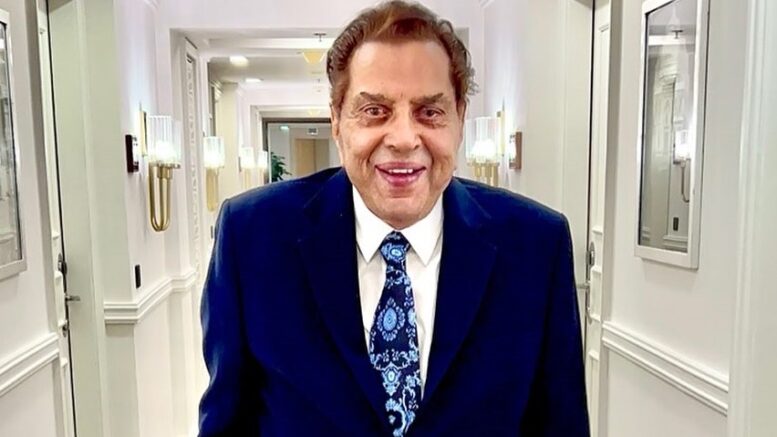
The Last Fade-Out: Dharmendra and the Golden Dust of a Bygone Era
The screen doesn’t go to black. Not yet. Instead, it holds on a close-up, weathered by 89 monsoons, etched with the laughter and heartbreak of nearly six decades. The news of veteran actor Dharmendra’s passing feels less like a breaking news alert and more like the final, gentle fade-out of a classic film we’ve all been watching our entire lives. With him, a certain kind of light—a warm, generous, slightly Technicolor light—flickers and dims, leaving our cinematic sky a little colder.
To call Dharmendra just a veteran is to call the Himalayas just a hill. He was a landscape. He was a territory of masculinity that stretched from the vulnerable, rain-drenched poet of Bandini to the boisterous, bicycle-riding Veeru of Sholay. He was the man who could, in the same breath, embody the stoic righteousness of Satyakam and the swaggering, almost mythological machismo of Dharam Veer. He didn’t just play characters; he inhabited archetypes, filling them with a blood-and-thunder humanity that was entirely his own.
What made him indelible was his tangible texture. In an age before airbrushed perfection, Dharmendra felt real. You could almost smell the Punjab earth on him in his early roles, see the sweat on his brow under the studio lights. His was a handsomeness hewn from rock and soul, his eyes capable of holding a profound sadness even as he delivered a punchline or a knockout blow. When he fought, it was a chaotic, glorious spectacle of flying limbs and shattered furniture, a symphony of sheer will over physics. When he loved, it was with a goofy, whole-hearted earnestness that made him impossibly endearing.
He was, perhaps, the last of the great bridge-builders. He bridged the black-and-white era of nuanced tragedy and the garish, glorious color era of the “Angry Young Man,” becoming a prototype himself. He bridged the gap between the art house and the massy single-screen theater, commanding respect in both. Most importantly, he bridged the distance between the screen and the audience. There was no veil of mystique; his later-life vulnerability on social media, his joyful, un-self-conscious embrace of his “grandfather” status, made him family. He was our Dharam Paaji—a brother, an uncle, a guardian of our collective movie-going memories.
His passing, then, is not just the loss of a man, but the closing of a certain volume of Indian cinema. It’s the bookend on an era where stars were forged in the furnace of raw talent and unadulterated charisma, not curated by algorithms. It was a time of grand gestures, of dialoguebaazi delivered with chests puffed out, of songs that were declarations, and of a simplicity of heart that shone through even the most convoluted of plots.
As the final reel of his life completes its run, we are left not with silence, but with an echo—the clang of a jail door breaking in Sholay, the jingle of a horse-drawn cart in Satyakam, the riotous laughter of Veeru drunk on love and country liquor, and the gentle, reassuring smile of a man who never seemed to take his own stardom too seriously.
The hero has ridden into the final sunset. But the stories, the songs, and the seismic impact of that legendary, ground-shaking presence? That, Mr. Dharmendra, is your legacy. And it is forever.
